Chapter 19 Electric Current and Quantity of Electricity
(1) What is the electric current?
When I asked the question:
 Can somebody tell me the definition of an electric current ?
 , I had the following answers from Mr.A and Ms.B .
The answer of Mr.A is as follows:
An electric current is total electric charge which passes  a plane of a certain range
 per unit time. Therefore, the relationship between a unit of an electric current (
 ) and a unit of electric charge (
 ) is as follows:


The answer of Ms.B is as follows:
An electric current is expressed as follows:electric current ( c s-1) minimum distance ( m )electric charge ( c )velocity ( m s-1)
 (Equality 19-1)
I think both answers are correct.
We call the left-hand side of (Equality 19-1) 'electric current element.'
I call the right-hand side of (Equality 19-1) 'space electric current.'
(2) Correspondence between 'four-dimensional space-time momentum' and 'vector of four-dimensional space-time electric current.'
Although 'quantity of electricity' is generally the same as 'electric charge' , I define that 'quantity of electricity' is different from 'electric charge.' I define that 'quantity of electricity ' is equivalent to 'momentum.'
So, I call 'electric charge' 'amount of electric charge', and call 'quantity of electricity' 'space electric current.'
Correspondence between a mass of a traveling object and an electric charge of a traveling object is as follows :
 Mass (
  )
)
 Amount of electric charge (
  ) Four-dimensional space-time momentum
  Four-dimensional space-time electric current
 Space momentum
  Space electric current
 Relative-time momentum
  Relative-time electric current
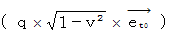 *Four-dimensional space-time velocity :
 Space velocity :
 Reltive-time velocity :
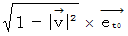 Magnitude of four-dimensional space-time velocity :
 Mass and energy are the quantity which changes dipending on akinetic relationship between an object and an observer. In suchmeaning, although they seem to be scalars, they are not scalars.A scalar is a quantity which does not change regardless of acoordinate conversion; a concrete example of scalar is 'amount ofelectric charge.'Therefore, I call the above-mentioned quantity which is similar toa scalar but different from a scalar 'vibe.' By the way, vector is aquantity with a direction. Both quantity and direction of a vectorchange as a result of a coordinate conversion. that is, a vectorchanges dipending on relationship on movement between anobserver and an observed object.
 Momentum and amount of electric current are vectors.
 Magnitude of 'relative-time momentum' is equal to 'rest mass.'Magnitude of 'vector of modified relative-time electric current' isnot equal to 'amount of electric charge.'
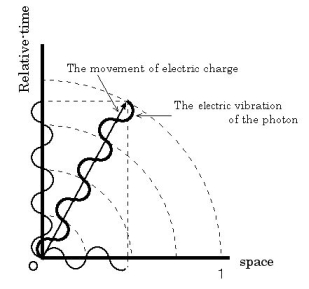
 Frequency of vibrations of a graviton is equal to the 'rest mass.'Frequency of electric vibrations of a photon is equal to 'amount ofelectric charge.'
 'Rest mass' and 'amount of electric charge' are constant regardledssof a coordinateconversion.
 The way of traveling of the vibrations of a photon is different fromthat of a graviton.
Please compare Figure 1601 with Figure 1902.
Figure 1601
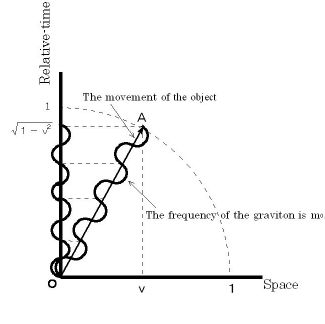
Figure 1902
Chapter 20Electric Force between Electric Charges
(1) New formula of 'Coulomb's law'As mentioned in Chapter 3 , 'Coulomb's law' is shown as follows by using a new system of units:
 (Equality 20-1)
However, in my relative theory 'Coulomb's law' is rewritten as follows:
 (Equality 20-2)
I call (Equality 20-2) 'electric force between electric charges.'
Now, I explain (Equality 20-2).
Please remenber 'law of vibrations of photon on electromagnetic field' mentioned in Chapter 19. I desdribe it again as follows :
A frequency of vibrations of photon in an object is constant, even if any observer traveling with linear uniform motion observes it. vibrations travel through space at a speed of  . There are two ways that vibrations travel as follows:a ) Vbrations travel keeping a form as it is. It produces the'Coulomb's force.'b ) Vibrations are decomposed into relative-time axis component andspace axes components. Then only the space axes components ofvibrations travel. It produces the 'Lorentz force.'
Not q but |
 | is used in (Equality 20-2). Owing to |
  | in
| in  system of units, it is | | . Therefore, you may think that it is right whichever we use. But it is wrong, because (Equality 20-2) is the formula which defines the electric force between two electric charges. Because, on one hand, square of the speed of light ( C 2 ) is a component of the formula of 'Coulomb's law', on the other hand, it is not a component of the formula of 'Lorentz force.'
In fact, it is not 'amount of electric charge' but 'four-dimensional space-time electric current' what produces 'Coulomb force', i.e. 'electric force between electric charges'.
(2) Electric field
I show following three phyisical items which produce an electric field:
a ) Four-dimensional space-time electric currentb ) The magnetic field which magnitude changesc ) The traveling magnetic fielda ) is my version of 'Coulomb's law.'
( Electric force between electric charges )b ) is called 'Faraday's law of electromagnetic induction.'
I call the mechanism of the production of an electric field by c ) 'Law of virtual electric field.' Its contents are as follows:
The virtual electric field ( ) produced by a magnetic field (
 ) traveling with a velocity (
 ) is as follows:
 Proviso:
  stands for exterior product.
This low comes from Lorentz force,
 , which is the force exerting influence on a traveling electric charge in an electromagnetic field.
Let us lead it from Lorentz force. Please consider how a traveling electric charge in an electromagnetic field is observed by Mr. A traveling with the same velocity as the electric charge. The value of Lorentz force is
 for Mr. A, because a electric current is for Mr. A. It is contrary to the principle of relativity. So, we consider that an electromagnetic field is produced. Now, let us think about it concretely.
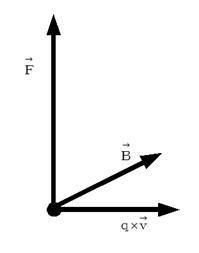
Please see Figure 2001. It shows Lorentz force (
 ) exerting influence on a space electric current in an electromagnetic field (
 ), which direction is perpendicular to the space electric current.
Figure 2001
From a viewpoint of Mr. A, the electric charge stands still, and the electromagnetic field is moving.
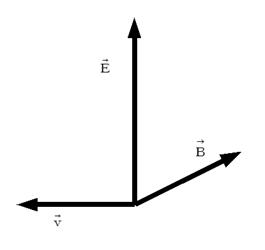
Owing to 'Law of a virtual electric field', a virtual electric field (
 ) is produced. It is shown in Figure 2002. The moving direction of the electromagnetic field is opposite to the space electric current in Figure 2001.
Figure 2002
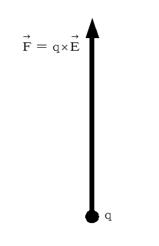
Then, we find that Coulomb force is exerting influence on the electric charge. The Coulomb force is equal to the Lorentz force.
Figure 2003
Chapter 21Magnetic Force between Electric Charges
(1) magnetic fieldI state following two physical items which produce a magnetic field:
a ) Relative space electric currentThe 'relative space electric current' is the vector obtained bymultiplying a space velocity of a positive electric chargeseparated from an electric zero point relative to a negative electriccharge separated from the same electric zero point by anamount of the separated positive electric charge.b ) The electric field which magnitude is changing.a ) is an electric current transmitted in a live conductor, so to speek.In the case of electric current transmitted in a live conductor, it is called 'Biot-Savart law.'
b ) was discovered by Maxwell.
I explain the 'relative space electric current' as follows:
The 'space electric current' mentioned in Chapter 20 does not produce a magnetic field. If it produces a magnetic field, on one hand, a magnetic field does not exist for the 0th observer observing stationary electric charges, on the other hand, a magnetic field exists for the 1st observer observing traveling electric charges. It is inconsistent with the principle of relativity.Therfore, we must consider as follows:
An electric field produces the force which separates the electric zero point into the different signed numbers of electric charges with the same absolute value of amount of an electric charge . In cotrast to this, when the electric zero point is separated into the different signed numbers of electric charges with the same absolute value of amount of an electric charge, a magnetic field is produced.When an electric zero point is separated into the different signed numbers of electric charges,
the relative space velocity of the separeted positive electric charge relative to the separeted positive electric charge forms the 'relative space electric current.'Please imagine a live straight conductor. In a live conductor, all positive electric charges keep still and many electrons with a negative amount of electric charge are moving in the same direction.
Therefore, we can consider as follows:
In a live conductor, all electric zero points which occupy all places in a conductor are constantly being separated into the different signed numbers of electric charges.Therefore, we see that 'relative space electric current' is formed in a live conductor.
(2) New formula of 'Lorentz force'
When the electric zero point is separated into the positive electric charge and the negative electric charge, let
 and
and  be the 'relative space electric current' and the space velocity of the object which has the amount of electric charge of
  .
.Now, let's think about the force that 'relative space electric current' exerts an influence on an object with electric charge on linear uniform motion.
I described in Chapter 3 that Lorentz force is shown as follows using a new system of units.
 (Equality 21-1)Note : stands for the operater of exterior product.For example, it is as follows :
However, in my relative theory, Lorentz force is rewritten as follows:
 (Equality 21-2)
Note : This equality contains some promises as follows :
Let  be an separeted 'amount of a positive electric charge' whenthe electric zero point separated into the different signed numbersof electric charges. Let
  be a space velocity of a separated positive electric chargerelative to a separated negative electric charge when an electriczero point separated into the different signed numbers of electric chages. Let be a space velocity of an object with an amount of electriccharge of .Then,
  is the 'space electric current.' Let |
 | be space intervals through which a photon emitted fromthe 'relative space electric current (
  ) ' travels to the objectwith an amount of electric charge of .|| is the same as a 'consequently distance of movement' of thephoton. The direction of is the same as a direction of relative to at the very moment the photon is emitted.
I call (Equality 21-2) 'magnetic force between electric charges.'
Let's prove (Equality 21-2) by using the virtual electric field. first, I will tell you the outline:
Firstly, We ask for the 'kinetic identical form' in which an object with electric charge received a magnetic force keeps still. ( We must not make the 2nd observer traveling with the same velocity as the object appear. Because the observing time intervals get long illusionally.)Secondly, we declare that the object receives not the Lorentz force, i.e. the magnetic force, but the electric force produced by the 'virtual electric field.' Then, we find the force produced by the virtual electric field.'
Finally, we assert that according to the principle of relativity the 'magnetic force between electric charges' is the same as the 'electric force produced by the virtual electric field'.
Now, let us do it concretely. Please see Figure 2101.
We call
a substance with an amount of electric charge of  electric charge .
There is a stational electric charge
 on the space-time origin. An electric charge on the space-time origin is traveling with linear uniform motion at a speed of
  in the positive direction of the X-axis. In this situation a 'relative space electric current' has been produced; it is
  . There is an electric charge on the space-time point
  with Y - coordinate of
  . The electric charge is traveling with linear uniform motion at a speed of
  in the positive direction of the X-axis. A photon emitted from the 'relative space electric current' reaches the electric charge , and then it produces the magnetic force exerting an influence on the electric charge .
Figure 2101
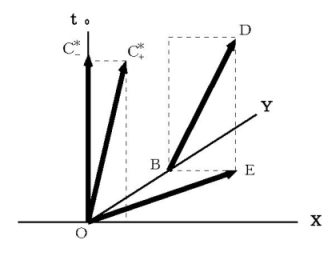





Next, we ask for X ' Y ' t 0' - coordinate system in which the electric charge
keeps still.Please see Figure 2102. To simplyfy, four-dimensional space is shown with two-dimentions.
Figure 2102
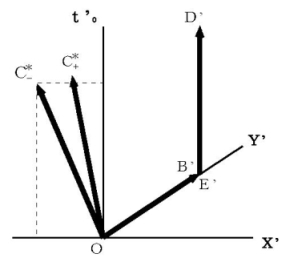


The electric charge
is traveling with linear uniform motion at a speed of in the direction of the X-axis. The electric charge is traveling with linear uniform motion at a speed of  in the positive direction of the X-axis.
We obtain the realistic speed of the electric charge
relative to the electric charge as follows:
Therefore, we see that the 'relative space electric current' does not change regardless of a coordinate conversion.
Moreover, when the coordinates of the space-time point
 ,
,  , and
, and  are as follows respectively, if we consider that X ' Y ' t0' - coordinate system of Figure 2102 is the 1st observer's coordinate system, the X Y t 0 - coordinate system of Figure 2101 shows the coordinate system of the 2nd observer traveling with linear uniform motion at a speed of relative to the 1st observer in the negative direcion of the X '-axis:
Therefore, X Y t 0 - coordinate system of Figure 2101 is the 'kinetic identical form' with X' Y' t'0 - coordinate system of Figure 2102.
Now, let us find how much force exerting an influence on the electric charge
in Figure 2102.The magnitude of a magnetic field on the space-time pooint
produced by the 'relative space electric current' is  , and its direction is the positive direction of the Z-axis. Because, magnetic field ( ) is expressed as follows:
The electric charge
is , however, not under the influence of a magnetic field, because it has no 'space electric current.' Instead it is under the influence of a 'virtual electric field.'Then, let us find the 'virtual electric field' on the space-time pooint
.The velocity of a magnetic field which produces the 'virtual electric field' is equal to the velocity of the electric charge
on the space-time origin which forms the 'relative space electric current ' of . Therefore, we see that the magnitude of the velocity of the magnetic field is .It is the negative direction of the X-axis.Therefore, according to the 'law of virtual electric field ' :
 , we obtain the magnitude of the virtual electric field (
  ) as follows:
It is the negative direction of the Y-axis.
Therefore, owing to the 'electric force expressed with electric field' :
 , we obtain the magnitude of the force exerting an influence on the electric charge is as follows:
It is the negative direction of the Y-axis.
Finally, we declare that the force exerting an influence on the the electric charge
in Figure 2101 is equal to the force exerting an influence on the electric charge in Figure 2102, because Figure 2101 is the 'kinetic identical form' with Figure 2102. We affirm that the 'magnetic force between electric charges' exerting an influence on the electric charge has the magnitude of and its direction is the negative direction of the Y-axis.